🐾 Blog Article
How PawSense AI Detects Pet Pain: The Science Behind the App
Discover how PawSense AI uses advanced computer vision, Google Gemini 2.5 Pro, and veterinary scales like the Feline Grimace Scale and Glasgow Pain Scale to detect pet pain from photos.
How PawSense AI Detects Pet Pain: The Science Behind the App
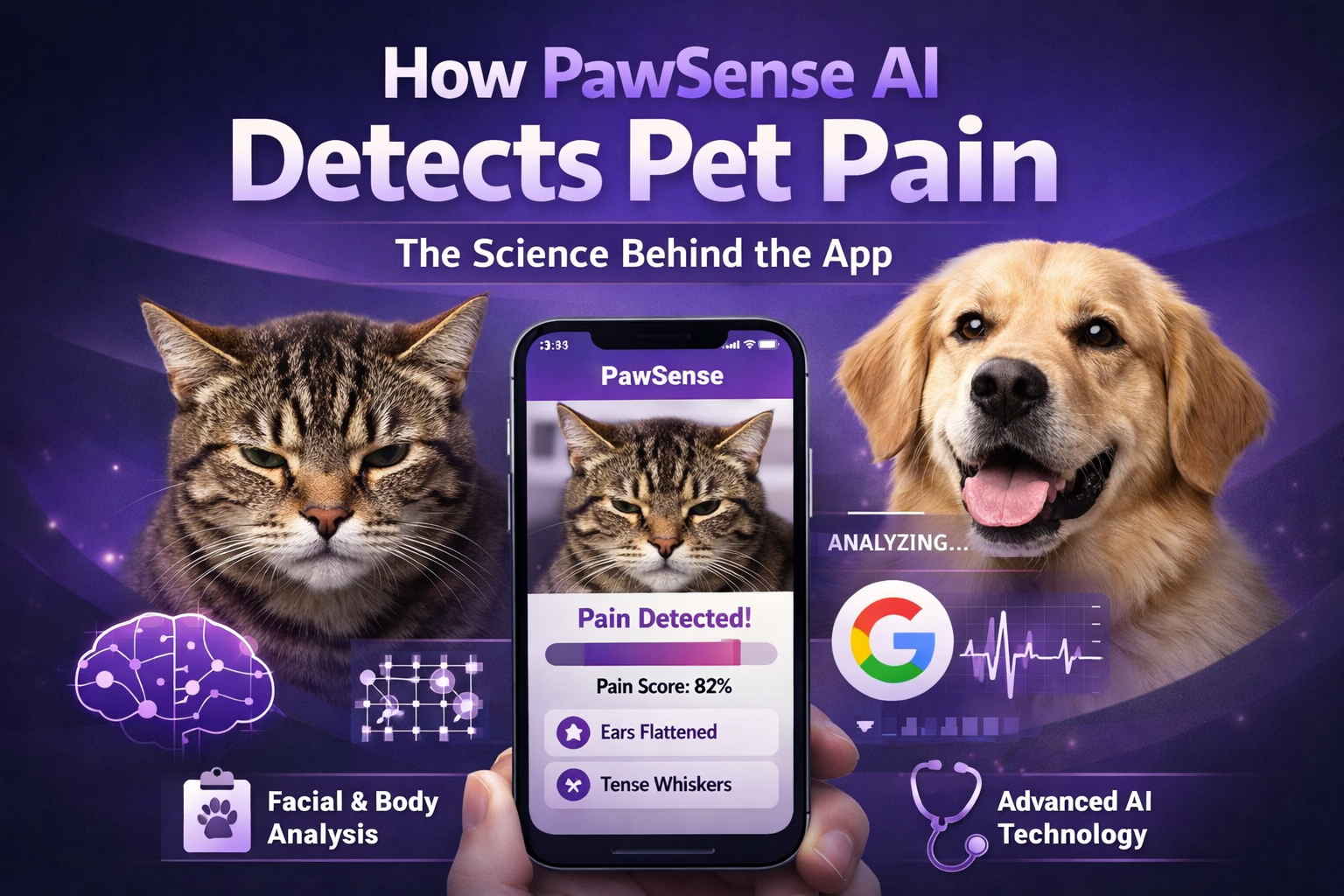
Pets are masters at hiding pain, often to protect themselves from perceived weakness. This inherent survival instinct makes it incredibly challenging for even the most attentive pet owners to spot subtle signs of discomfort or illness. Untreated pain can lead to chronic conditions, reduced quality of life, and even behavioral issues. This communication barrier between pets and humans is a significant concern for millions of pet owners worldwide, leaving many feeling helpless and worried about their furry companions' well-being.
At PawSense, we understand this challenge deeply. That's why we've developed an innovative solution powered by cutting-edge AI veterinary technology designed to help you detect pet pain from photos. Our app leverages sophisticated artificial intelligence, specifically Google's advanced Gemini 2.5 Pro vision model, combined with established veterinary pain assessment scales like the Feline Grimace Scale (FGS) and the Glasgow Composite Pain Scale (GCPS) for dogs. This article delves into the fascinating science and technology that underpins PawSense, revealing how we're transforming proactive pet care by giving a voice to your pet's silent language.
Join us as we explore the intelligent systems working behind the scenes, from advanced computer vision to validated veterinary methods, empowering you to better understand and care for your beloved animals.
Google Gemini 2.5 Pro: Vision AI for Animal Analysis
The heart of PawSense's ability to interpret your pet's subtle cues lies in its integration with Google Gemini 2.5 Pro, a highly advanced multimodal large language model. While many AI models excel at understanding human language and images, Gemini 2.5 Pro's robust vision capabilities make it exceptionally powerful for analyzing intricate visual details, even those from the animal kingdom. This model's strength lies in its ability to process complex visual data, recognize patterns, and understand contextual information in ways that simpler AI systems cannot.
For PawSense, Gemini 2.5 Pro is meticulously trained and fine-tuned to focus on the unique physiological markers of pain in animals. Unlike human pain, which can be verbally expressed, pet pain manifests through changes in facial expressions, body posture, and overall demeanor. Gemini 2.5 Pro's vision component is trained on vast datasets of animal images, including those where pain has been clinically validated by veterinarians. This training enables it to identify minute shifts in ear position, eye squinting, muzzle tension, head tilt, and even the subtle rigidity or relaxation of various body parts that indicate discomfort. This forms the foundational intelligence that allows PawSense to accurately "see" and interpret the often-hidden signs of pain. To learn more about this core technology, explore Gemini 2.5 Pro & PawSense: The Brain Behind AI Pet Pain Detection.
Understanding Veterinary Pain Scales: FGS and GCPS Explained
While advanced AI can process visual data, it needs a scientific framework to interpret that data meaningfully. This is where established veterinary pain scales, specifically the Feline Grimace Scale (FGS) for cats and the Glasgow Composite Pain Scale (GCPS) for dogs, become indispensable. These scales are not arbitrary checklists; they are scientifically validated tools used by veterinarians worldwide to objectively assess pain levels in their patients. They provide a standardized way to quantify pain based on observable behavioral and physiological indicators.
The Feline Grimace Scale, for instance, evaluates five key action units in a cat's face: ear position, orbital tightening (squinting), muzzle tension, whisker change, and head position. Each unit is scored from 0 (not present) to 2 (obviously present), and the total score indicates the likelihood and severity of pain. Similarly, the Glasgow Composite Pain Scale for dogs assesses multiple dimensions including vocalization, body posture, activity level, response to palpation, and overall demeanor. By integrating these scales, PawSense translates the AI's visual observations into a language that aligns with veterinary medical standards. This bridge between AI analysis and clinical metrics ensures that PawSense's output is not just an algorithmic guess, but a data-driven assessment rooted in veterinary science. For a deeper dive into these crucial tools, check out Demystifying Pet Pain Scales: FGS & GCPS Explained for Owners. If you're a cat owner, you might also find Understanding Your Cat's Pain: The Feline Grimace Scale with PawSense particularly insightful, or for dog owners, Dog Pain Assessment Made Easy: PawSense & The Glasgow Composite Pain Scale.
From Photo to Pain Score: Our Detection Process
The journey from a pet owner uploading a photo to receiving a pain assessment is a streamlined, intelligent process within the PawSense app. It begins with you:
- Photo Upload: You take a clear photo of your pet, ideally showing their face and body posture. The app guides you on optimal photo conditions to ensure the best analysis.
- Behavioral Details: Alongside the photo, you provide crucial contextual information about your pet's recent behavior, such as changes in appetite, activity levels, or specific events like a recent injury or surgery. This qualitative data complements the AI's visual analysis.
- AI Vision Analysis: This is where Google Gemini 2.5 Pro comes into play. The AI meticulously analyzes the uploaded image, scrutinizing various features. For cats, it focuses on the Feline Grimace Scale parameters – ear position, orbital tightening, muzzle tension, whisker changes, and head position. For dogs, it assesses elements relevant to the Glasgow Composite Pain Scale, looking at subtle shifts in body language, facial expressions, and overall posture.
- Data Integration & Scoring: The AI's visual findings are then cross-referenced with the behavioral details you provided. This holistic approach allows for a more accurate and nuanced understanding of your pet's condition. The system then generates a pain probability score, indicating the likelihood of your pet experiencing pain, along with a dimension-by-dimension breakdown based on the respective pain scale.
- Report Generation: Finally, PawSense compiles this data into an easy-to-understand report. This report includes the pain probability, detailed analysis of each assessed dimension (e.g., specific grimace elements for cats, or posture components for dogs), possible causes of discomfort, home observation tips, and clear recommendations on when a vet visit is advisable. You can get an instant AI analysis with our Free Pet Pain Check: Instant AI Analysis with PawSense.
This comprehensive process ensures that PawSense delivers insights that are both scientifically grounded and practically actionable, empowering you to make informed decisions about your pet's health.
The Accuracy and Reliability of PawSense's AI
When it comes to your pet's health, accuracy and reliability are paramount. PawSense is committed to providing assessments that pet owners can trust. Our AI veterinary technology is not a static system; it's built on a foundation of continuous learning and rigorous validation. The AI models are extensively trained on vast datasets of images and clinical data, including cases where pain has been expertly assessed by veterinarians. This training process allows the AI to learn to differentiate between normal expressions and those indicative of pain with high precision.
Furthermore, our system's accuracy is continuously refined through ongoing testing and validation against new clinical data. We understand that AI is a powerful tool, but it is not a substitute for professional veterinary care. PawSense is designed to be a proactive screening tool, an early warning system that helps pet owners identify potential issues before they become severe. By empowering you to detect pet pain from photo evidence and behavioral observations, PawSense allows for earlier intervention, which can significantly improve outcomes and prevent prolonged suffering. For a broader view of how our app helps, consider reading PawSense: AI Pet Pain Detection for Dogs & Cats - Your Pet's Silent Language Revealed. We believe that equipping pet owners with the ability to monitor their pets' well-being more closely is a crucial step towards comprehensive animal care, making the benefits of early detection evident. Learn more about Why Early Pet Pain Detection is Crucial for Your Furry Friend's Life.
Frequently Asked Questions
Q1: How accurate is PawSense AI compared to a veterinarian?
A1: PawSense AI is a highly accurate screening tool, trained on extensive data validated by veterinary experts. It helps identify potential pain signals you might miss. However, it is not a diagnostic tool and does not replace a physical examination by a veterinarian, who can provide a definitive diagnosis and treatment plan.
Q2: What kind of photos work best for PawSense?
A2: For the best results, use clear, well-lit photos where your pet's face and body posture are visible. Avoid blurry images, extreme angles, or photos where your pet is obscured. Taking photos when your pet is relaxed and also when you suspect pain can provide valuable comparative data.
Q3: Can PawSense detect specific types of pain or only general discomfort?
A3: PawSense identifies general pain signals by analyzing expressions and posture against established pain scales. While it can suggest the presence and severity of pain, it does not diagnose the specific cause (e.g., arthritis vs. injury). The detailed reports can highlight specific grimace elements or posture changes that a vet can then use for further investigation.
Q4: Is PawSense safe for my pet's data and privacy?
A4: Yes, PawSense prioritizes your pet's data privacy and security. All uploaded photos and behavioral details are processed securely and used solely for analysis within the app. We do not share your data without explicit consent.
Q5: Can I use PawSense for any breed of cat or dog?
A5: Yes, the Feline Grimace Scale and Glasgow Composite Pain Scale are designed to be applicable across various breeds of cats and dogs. The AI is trained on diverse datasets to account for breed-specific variations in appearance, allowing it to generalize effectively across different animals.
Conclusion
Understanding when your pet is in pain is one of the most profound challenges of pet ownership. Traditional communication barriers have often left pet parents guessing, leading to delayed diagnoses and prolonged suffering. PawSense bridges this gap by harnessing the power of advanced AI veterinary technology, transforming your smartphone into a sophisticated tool for proactive pet health monitoring. By integrating Google Gemini 2.5 Pro vision with the scientifically validated Feline Grimace Scale and Glasgow Composite Pain Scale, PawSense empowers you to detect pet pain from photos with unprecedented ease and insight.
This innovative approach ensures that you, the pet owner, are equipped with reliable information, allowing for earlier intervention and better quality of life for your beloved companion. PawSense isn't just an app; it's a revolutionary partner in pet care, helping you understand your pet's silent language and respond with confidence. Don't let your pet's pain go unnoticed.
Take the first step towards a deeper understanding of your pet's well-being. Try PawSense today and give your furry friend the care they deserve.